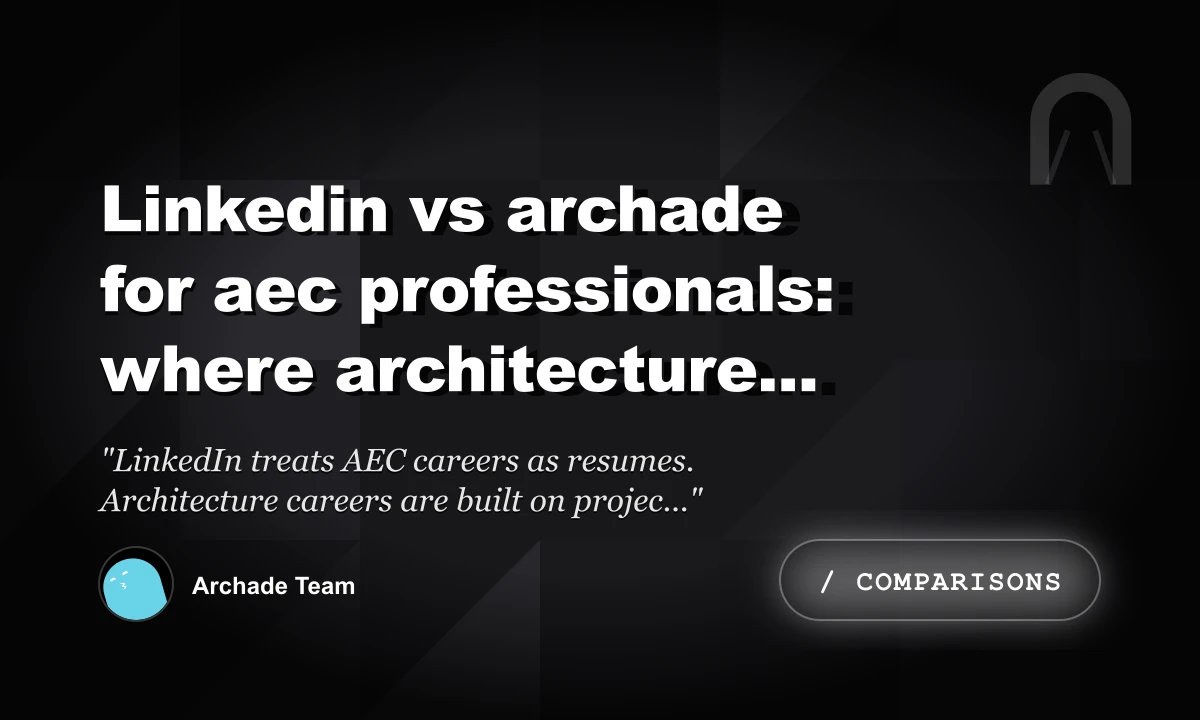
LinkedIn vs Archade for AEC Professionals: Where Architecture Careers Actually Compound
LinkedIn treats AEC careers as resumes. Architecture careers are built on projects. Here\
LinkedIn vs Archade for AEC Professionals: Where Architecture Careers Actually Compound
LinkedIn treats AEC careers as resumes. Architecture careers are built on projects. Here's why.
LinkedIn vs Archade for AEC Professionals: Where Architecture Careers Actually Compound
Most AEC professionals don't struggle with talent.
They struggle with visibility.
Not Instagram visibility. Not follower counts.
Professional visibility:
- Can firms understand your work quickly?
- Can your projects speak without you being in the room?
- Can opportunity find you without cold outreach?
The Real Problem We're Solving
Before we compare platforms, let's understand the actual problem.
AEC professionals have incredible work. They have relevant skills. They have strong experience.
But they're invisible online.
Their projects are buried in portfolio sites nobody visits. Their skills are reduced to keywords nobody trusts. Their experience is flattened into job descriptions nobody believes.
This isn't a platform problem. This is a representation problem.
How do you represent project-based, context-heavy, visual, collaborative careers in systems built for linear, text-first, individual, transactional careers?
Why LinkedIn Exists (And Why It Succeeded)
LinkedIn solved a real problem.
Before LinkedIn:
- Resumes lived in inboxes
- Careers were invisible outside immediate circles
- Hiring scaled poorly
- Professional identity was fragmented
LinkedIn standardized professional identity. That's why it won.
It created a universal format:
- Resume-like profiles
- Experience sections
- Connection networks
- Job board integration
This worked beautifully for careers built on: promotions, titles, company names, and industry switches.
Where LinkedIn Quietly Breaks Down for AEC
Architecture, engineering, and construction are not resume-first careers.
They are:
- Project-led (careers compound through projects, not promotions)
- Context-heavy (what you did matters more than where you worked)
- Visual and collaborative (work needs to be seen, not just described)
- Slow-moving but high-stakes (projects take years, mistakes cost millions)
LinkedIn treats projects as bullet points. AEC treats projects as the work itself.
The Mismatch
On LinkedIn, your best project becomes:
- One line in an experience section
- Hidden under a company name
- Reduced to keywords
- Disconnected from visual work
A firm reviewing your profile can't:
- See what you actually did
- Understand your role in context
- Evaluate project complexity
- Assess collaboration fit
They see a resume, not your work.
The Hidden Cost of This Breakdown
When projects are reduced to text:
For professionals:
- Firms can't assess real capability
- Early-career talent becomes invisible
- Mid-career professionals plateau
- Growth stays linear instead of compounding
For firms:
- Hiring defaults to brand names and titles
- They can't see actual work before interviews
- Context is missing (what type of projects? what role? what complexity?)
- Fit assessment is impossible
For the industry:
- Talent stays hidden
- Opportunities don't match projects
- Hiring is transactional, not contextual
- Careers don't compound
This isn't a LinkedIn problem. It's a mismatch problem.
LinkedIn works for resume-first careers. AEC careers are project-first.
What Archade Does Differently at the System Level
Archade starts from a different assumption:
In AEC, projects are the primary unit of professional signal.
Everything else:
- Roles
- Companies
- Hiring
- Reputation
- Skills
- Network
Should attach to projects, not the other way around.
The System Difference
LinkedIn's model:
Person → Company → Experience → Project (as bullet point)
Archade's model:
Project → People → Companies → Opportunities
This isn't cosmetic. It's structural.
When projects are first-class entities:
- Work speaks for itself (firms see actual projects, not descriptions)
- Context is preserved (role, collaborators, challenges, skills)
- Network compounds (projects connect to opportunities)
- Growth accelerates (opportunities multiply through projects)
The Comparison (Now That You Know Why It Matters)
| Dimension | Archade | |
|---|---|---|
| Core Unit | Resume | Project |
| Network Logic | Generic connections | Projects connect to opportunities |
| Hiring Signal | Titles and keywords | Actual work in context |
| Discovery | Algorithmic feed | Project-based matching |
| Context | Flattened to text | Preserved: role, collaborators, challenges |
| Verification | None | Colleagues confirm, companies verify |
| Network Effects | Weak (connections don't compound) | Strong (projects create opportunities) |
| Career Growth | Linear (promotions) | Compound (projects multiply) |
| Industry Fit | Works for all | Built specifically for AEC |
The difference isn't features. It's fundamental architecture.
LinkedIn assumes professional identity is resume-shaped. Archade assumes it's project-shaped.
Who Should NOT Use Archade
Archade is not for everyone.
If your work:
- Isn't project-based (you're in sales, operations, or pure management)
- Doesn't benefit from visual context (you work in abstract domains)
- Relies on broad industry switching (you change industries frequently)
- Is purely transactional (one-off gigs with no relationship building)
LinkedIn is still the right tool.
LinkedIn works for careers built on:
- Company names
- Industry connections
- Generic professional presence
- Broad network reach
If that's you, use LinkedIn. We're not competing with that.
The Irreversible Takeaway
LinkedIn helps you exist professionally.
Archade helps your work speak for you.
One is about presence. The other is about progression.
LinkedIn: Optimized for the lowest common denominator. Works for everyone, which means it works perfectly for no one in particular.
Archade: Optimized for AEC professionals. Works specifically for the built world, which means it works perfectly for you.
Different tools. Different outcomes.
If you're an AEC professional building a career on projects, not just promotions, the choice is clear.
Ready to build a career where your work speaks for you? Join Archade.
Read Next