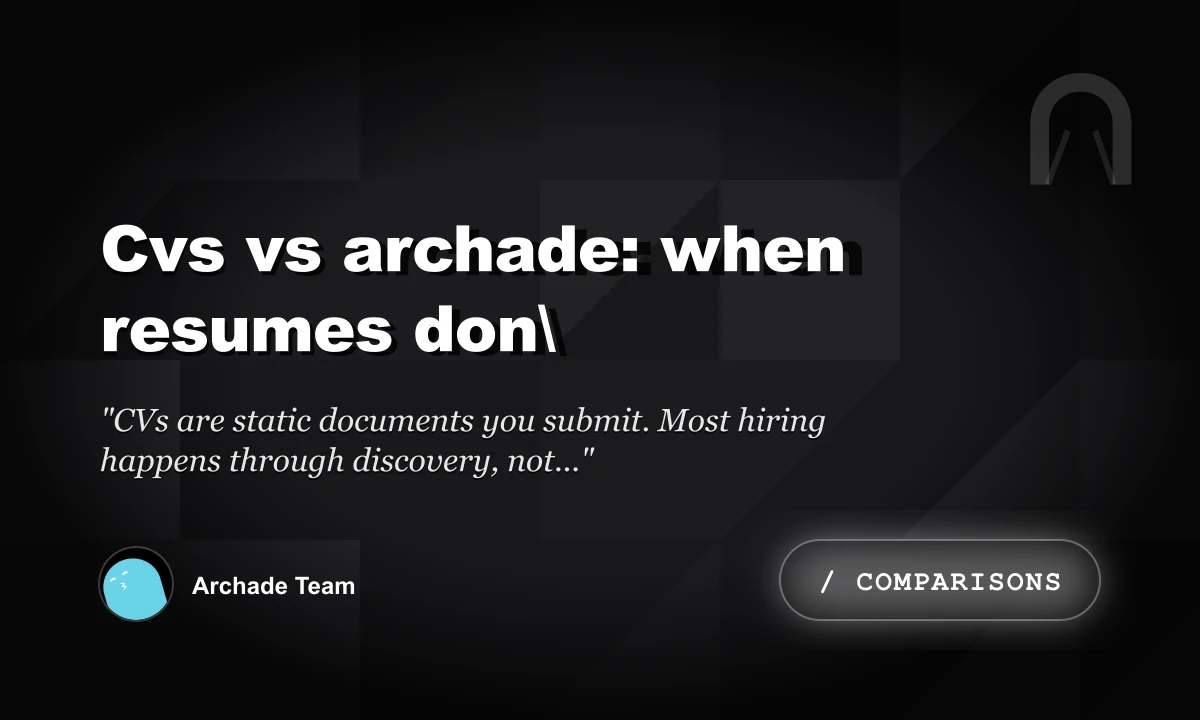
CVs vs Archade: When Resumes Don\
CVs are static documents you submit. Most hiring happens through discovery, not applications. Here\
CVs vs Archade: When Resumes Don't
CVs are static documents you submit. Most hiring happens through discovery, not applications. Here's why.
CVs vs Archade: When Resumes Don't Get You Discovered
Resumes don't get you discovered. Living professional records do.
Here's why submitting static documents kills opportunity for AEC professionals.
The Real Problem We're Solving
You've polished your CV. You've optimized for ATS. You've submitted to 50 jobs.
Then you wait.
You realize:
- Resumes sit in inboxes (nobody reads them)
- You're competing with thousands (low probability)
- Discovery doesn't happen (passive applications)
- Career growth stays linear (one application = one opportunity, maybe)
You've optimized for submission, not discovery. That's the problem.
Why CVs Exist (And Why They Succeeded)
CVs solved a real problem.
Before CVs:
- Professional qualifications were fragmented
- Hiring required personal connections
- Qualifications didn't scale
- Professional identity was unstructured
CVs standardized professional qualifications. That's why they won.
They created:
- Structured format (consistent presentation)
- Keyword optimization (ATS compatibility)
- Formal submission (professional process)
- Standardized qualifications (easy to compare)
This worked beautifully for: formal applications, keyword optimization, and structured hiring.
Where CVs Quietly Break Down for AEC
Architecture careers are not submission-first careers.
They are:
- Discovery-driven (most hiring happens through discovery, not applications)
- Context-heavy (firms need to understand your work, not just read descriptions)
- Network-dependent (opportunities compound through connections, not cold applications)
- Capability-focused (firms hire based on actual work, not just keywords)
CVs treat qualifications as static documents. AEC professionals treat qualifications as living records.
The Mismatch
On your CV, your project becomes:
- One line in an experience section
- Reduced to keywords
- Hidden under a company name
- Static and passive
Meanwhile:
- Firms can't discover you (CVs aren't searchable by capability)
- They can't understand your work (text descriptions don't explain projects)
- They can't assess fit (resumes don't show context)
- Hiring doesn't happen proactively (resumes require submission)
You've optimized for submission but killed discovery.
The Hidden Cost of This Breakdown
When qualifications are static:
For professionals:
- Discovery doesn't happen (resumes require submission)
- Opportunities don't compound (one application = one opportunity, maybe)
- Network doesn't build (resumes don't create connections)
- Career growth stays linear (no compounding)
For firms:
- They can't discover talent (resumes sit in inboxes)
- They can't understand context (text descriptions don't explain work)
- They can't assess fit (resumes don't show network)
- Hiring defaults to applications (not discovery)
For the industry:
- Talent stays hidden (resumes require submission)
- Opportunities don't compound (no network effects)
- Hiring depends on applications (not discovery)
- Careers don't compound for most
This isn't a CV problem. It's a submission vs discovery problem.
CVs work for formal applications. Most AEC careers need professional discovery, not just submission.
What Archade Does Differently at the System Level
Archade starts from a different assumption:
In AEC, living professional records are the primary unit of opportunity creation.
Submission is necessary but not sufficient. Discovery compounds opportunities.
When professionals maintain living records:
- Discovery happens (firms find you proactively)
- Opportunities compound (network effects multiply)
- Network builds (projects connect to opportunities)
- Career growth accelerates (compounding vs linear)
Archade enables professional discovery. Every project can:
- Enable discovery (firms find you proactively)
- Show context (role, collaborators, challenges)
- Build network (projects connect to opportunities)
- Compound opportunities (network effects)
This isn't a resume. This is living professional infrastructure.
The System Difference
CV's model:
Project → Resume → Application → Wait for Response
Archade's model:
Project → Living Record → Discovery → Opportunity → Career Growth
When living records are the focus:
- Discovery happens (firms find you proactively)
- Context is preserved (role, collaborators, challenges)
- Network compounds (projects connect to opportunities)
- Career growth accelerates (compounding)
The Comparison (Now That You Know Why It Matters)
| Dimension | CVs | Archade |
|---|---|---|
| Format | Static document | Living record |
| Discovery | Passive (requires submission) | Active (firms find you) |
| Context | Flattened to text | Full (role, collaborators, challenges) |
| Verification | None (claims aren't verified) | Built-in (colleagues confirm) |
| Network | None (resumes don't create connections) | Built-in (projects connect to opportunities) |
| Opportunity | Passive (one application = one opportunity, maybe) | Active (opportunities compound) |
| Career Growth | Linear (no compounding) | Compound (network effects multiply) |
| Timing | Slow (wait for response) | Immediate (discovery happens now) |
The difference isn't features. It's fundamental architecture.
CVs optimize for submission. Archade optimizes for discovery.
Who Should NOT Use Archade
Archade is not for everyone.
If your work:
- Requires formal application processes
- Benefits from ATS optimization
- Depends on keyword matching
- Is primarily about submitting to advertised jobs
CVs are still the right tool.
CVs work for careers built on:
- Formal applications
- Keyword optimization
- Structured hiring
- Traditional processes
If that's you, use CVs. We're not competing with that.
The Irreversible Takeaway
CVs help you submit qualifications.
Archade helps firms discover your capability.
One is about submission. The other is about discovery.
CVs: Optimized for formal applications. Works for submission, doesn't enable discovery.
Archade: Optimized for professional discovery. Works for proactive opportunities, not just passive applications.
Different tools. Different outcomes.
If you're an AEC professional building a career, not just submitting resumes, the choice is clear.
Ready to get discovered, not just submit resumes? Join Archade.
Read Next